New year, same me, not a bad thing

I won’t make a grand commitment to writing every day, or even weekly. I’m stubborn in my ambivalence, although with wobbly legs.

I am trying to “manifest” a life designed by me for my one, true beautiful me. If you had asked my emerging adult self what I wanted out of my life, I would have been want for a clear vision. I think the speed of time as I age has hastened a better grip on wanting to sort this out more clearly. I envision my current life and life ahead, having better balance and less grind; Speaking up over quiet omission; taking what I need over asking permission.

When we moved to Minnesota in 1991, my betrothed began graduate school almost immediately after our wedding, and we settled in to our one bedroom apartment at the Palisades. I don’t recall how we found the Palisades apartment complex—we didn’t have google or the internet yet. We learned about the complex before we moved there, and we arranged for an apartment, sight unseen. Somehow we figured out how to send away for information and received a pocket folder with an application and pages that described the layouts of each unit. Our apartment was on the 3rd floor, in one of the eight buildings (I made that up,) of the complex.

Ours was 800 square feet with an entry that went to the left into a petite galley kitchen, or straight ahead to enter a pie-shaped living room, with an adjacent small bedroom and bathroom. The “dining room,” an extension of the galley kitchen, opened also to the living room, where a balcony and sliding door filled the far wall. We had a mauve futon and a papasan chair from my college apartment, along with an antique Queen sized bed and matching dresser that my parents allowed us to take with us. I recall the spoiled privilege of just assuming I could take “my” bed and dresser, as I had used them throughout my childhood–they were “mine.” I recall my mom’s reaction to my less request than proclamation–a mix of disdain, surprise and ultimately unselfish acquiescence to my assumption. In the category of what goes around comes around, our oldest had a similar conversation with me, when he loaded his Yukon with the lower part of the bunk beds and dresser we bought for his childhood room.

My journey to find employment was less defined than my partner’s decisive plans, (to this day, something I have long been attracted to–his unswerving sense of goal direction.) At age 22, we had just finished college, and I had sought little guidance about finding employment, or even narrowing my ideas about what employment might look like for me with a really broad, liberal arts degree and only limited employment experiences working as teller, flower shop assistant and a line cook. I had an entitled notion that I could send resumes to area fortune 500 companies in the Twin Cities and I would be barraged with calls for interviews.

When after a month of no calls or responses to my carefully printed cover letters and resumes on marble vellum stock, he gently suggested I should find some way to earn a living, as his $8,000 annual graduate stipend was going to have limitations for our shared living. So I went to the want ads in the back of the newspaper and found a teller job at the Burlington Northern Railroad Credit Union, downtown St. Paul. I don’t recall much about the job, except it was a rather small, dark office space, located inside a building, accessible from the internal habitrail-hamster tubes, that connected many of the buildings throughout the Twin Cities. You could enter a random building, take an escalator to the 2nd floor and enter an elaborate system of heated tubes in order to avoid the extreme winter weather conditions common between November and April in Minnesota.

I didn’t last more than four months at the BN Credit Union. Our manager there was an uptight, 30-something lanky white guy, who only spoke to us if we made mistakes. He was too uncomfortable to be anything but direct, which really poked at my inner perfectionist and I felt perpetually doomed to make mistakes. It didn’t take long to feel frustrated by boredom, insecure about the stink-eye glances from our manager when I arrived late, and a complete lack of vision for where this would take me in life. So, when an ad appeared for “Activities Assistant, in the want ads, “experience with music and art encouraged,” I promptly called the number and scheduled an interview.

I have always thought about St. Anthony Park Home as my first “real” workplace. Owned by John, a really kind man, who began his career in that Nursing Home as the Custodian, it was what would now be thought of as a boutique nursing home, a unicorn that remained free of corporations bent on revenue streams dependent on frail humans in need of care and support.

The first person I met, I’ll call him Fred, shuffled over to me with mammoth, scuffed up Bass lace-ups to propel his wheelchair near the front door. His white hair, in need of trimming, fluffed in whisps along his long forehead, and he reached out with giant, silken hands. He asked me if I’d “Get out of here,” with him and a nurse intervened, guiding me to a table in the dining room. Fred waved a wistful and tearful farewell, as if I were his long, lost love, while Dolores, a Franciscan nun, and the designated Social Work Director, walked over from her nearby office and asked what brought me in. She would be my first Social Work mentor and guide.

I interviewed with Susan, summoned by Dolores, who proclaimed with the confidence and fierce smile of a tribal healer, “Hire this woman!” This would begin a truly unique era of friendship and learning about myself as a young adult. I had long thought of myself as a tomboy, and while I had girlfriends throughout elementary, secondary education, and college, I hadn’t fully shared much about my authentic self with other girls or women until this experience. Bonnie, our Director of Nursing, would also share a role of mentor for me. Dolores, previously a school administrator, would become the administrator of a care facility for Franciscan nuns. Dolores hired Bonnie as the Director of Nursing there and together they managed the psychosocial medical care needs of women who had dedicated their lives to serving the Catholic church—until that is, they left together, to work for John at St. Anthony Park Home.

Bonnie and Dolores frequently invited a small group of us, Susan, Lisa, Shirlee and Lynn, to Bonnie’s two-flat St. Paul apartment, for dinner. They shared stories about their work together over the years, Bonnie’s Leukemia diagnosis and her tireless commitment to work, in spite of her health. Dolores told us she had found Bonnie at the nurse’s station, more than once in the midst of her own experimental chemo treatments, still determined to organize charts, policies and procedures.

They told us about vacations they had taken together, a trip to Maine where Bonnie—who had never been to Maine in her life—suddenly told Dolores, “Never mind about the map, I know where we are,” and she proceeded to navigate them to Kennebunkport and the inn where they would stay. She said she would later experience a past-life regression and learned that she had lived there during the time of Protestant persecution of women as witches. She refused to share more about what she learned, as she said she believed her bad health today was likely some kind of karmic penance for the things she had done in that past life.

Bonnie also described her curiosity about Astral Projection, and how when practicing late one night, she was able to project her face through a glass paperweight on Dolores’ bedside table. We listened, slack-jawed with disbelief until she cajoled Dolores to corroborate her story. Do made the sign of the cross and said the experience scared the “living tar out of her,” and she made Bonnie promise she would never do it again. To this day I think Dolores was crossing her fingers behind her back, but I’m desperate to believe truth in the story. Bonnie told us stories about her life, her sister Shelley, who had been brain-washed by and later extricated from a religious cult sometime in the 80’s, She would also tell Lisa and me about and the birth of her first and only child, Erin, who had died shortly following birth, due to encephalitis. I felt like a fool for asking her why she had never married or had children, but she answered unapologetically and without hesitation with her story. We were gobsmacked by the rich experiences of these women, 65 and 45 years old, respectively.

Bonnie and Dolores mentored each of us, encouraging us to recognize our strengths. Bonnie was a pianist and would accompany me on the flute for sing-alongs for our residents. Dolores encouraged me to shadow her when assessing new residents or when offering them emotional support for the many losses and transitions they were managing. Dolores would be the first of several mentors who guided me to go back to school for a Masters in Social Work years later. Bonnie also created a distinct para-professional role called Rehabilitation Assistant for Lisa, who started there as a CNA, but who demonstrated smarts, and a commitment to quality car. Lisa was organized and capable of managing a caseload of those who no longer qualified for Medicare-covered therapies, but who benefitted from continued support for maintenance health. Bonnie and Dolores had relationships with all of the staff, bonding and encouraging everyone to value the care we provided to our residents, but also supporting our individual lives, hopes and dreams.

One day, as I walked past her office, Bonnie invited me in and swiftly gestured to close the door. “You’re depressed, Beth. Do you know what that is?” Shocked and caught off guard, I received her words with the blunt edge of truth to denial. My previous exposure to language about mental health, had consisted of references to “Nervous Breakdowns,” and the idea that someone was “crazy,” if they had any open indications of mental illness. “You’re pale and your usual effervescence has lost its sparkle. Talk to me.” She normalized depression by saying this was an experience she had been through on her own health journey, along with the experiences of loss. She said with a read-my-lips-clarity, there wasn’t a person in our workplace who hadn’t understood depression in some way personally.

She shared her concern for me and offered her help, if I wanted it. There was a mix of surprise and some resentment for me, about being outed for something I still thought more of with stigma than understanding. I felt the relief of being seen, to have words placed across a gap of something I had felt both too proud and ashamed to identify for myself. I was admittedly miserable, having trouble rising in the morning, an over-active appetite, feelings of worthlessness, even thoughts of death–all symptoms of depression. With her encouragement, I would see a therapist for the first time at age 23 and I even tried a first anti-depressant–the start of a long journey toward finding a better sense of my self, a self independent of my family of origin, with some better understood personal beliefs, values and goals.

I am so grateful for the mentors I have met on this, my heroine’s journey. Not that mine is so special or unique, but a tribute to the way mentors can guide us back to helping us define a self. It isn’t so much the advice, but their raw sharing of flaws, kindness, their pasts, their generous presence that allows one to be seen and therefore also see what is witnessed by someone who views you as precious. The witness of inherent beauty of each one self–the self that no longer depends on assurance, agreement, approval or attention from others, but who stands in gorgeous defiance of fear and steps forward. I enjoy when a new mentor emerges and sends that neutral shrug, “you’ll either do it, or you won’t. That’s up to you.”

Bonnie’s life ended just before my baby’s first birthday thirty one years ago. She included each of us in her funeral planning—Lisa, Susan and Dolores gave readings and I played my flute, at her request, to the hymn, “In the the garden.” We were each named a flower in her garden of life, Susan a freesia, Lisa a daisy, Lynn a Lily, Bonnie herself was the Bird of Paradise, Dolores a Rose and I was a Carnation, spicy and multi-colorful in Bonnie’s naming. A bouquet of these flowers sat alongside her photograph at her memorial celebration.

I still have Bonnie’s notes to me, little card and affirmations given along the way, bursts of encouragement, an elixir that still calls, “keep moving, you’ll find your way.” Years later, a life of school, raising children, supporting a driven and ambitious partner, have I slowly begun to recognize that I can steer my own path and step forward for myself. I’m still me, not a bad thing.
Exits, Endings and Progress

The researcher

I listened to the Hidden Brain podcast the other day and I chose the episode because it was about quitting. The theme matched my thoughts and inaction. Quitting is a thought I have when things feel painful and untenable. A voice inside says, “ I can’t,” or worse and more offensive, but born of burn out, “ I don’t want to.”

What protector is this, who wants to quit? I haven’t named her, but she is one of many parts that prefers comfort over courage, good feels over failing, soft, cloudy pillows over heart pounding anxiety. She’s a scaredy cat who loves to hide and close her eyes. Here, kitty kitty.

I rather decisively quit a good paying job a few years ago—really good pay for a Social Worker—we don’t make it to six figures usually—but as a Director, I had. “That’s why you make the big bucks,” a colleague joked, as I openly described a panic attack I was having over team behavior. I used to frequently say that it was a toxic system, but I had a part in it too, and I couldn’t manage my anxious reaction to it, so I chose to leave during a time when I could have helped more people in my community.

I think back on that a lot. We weren’t allowed an additional budget to develop other staff support, but I know I could have tried harder, if I had calmed down, stopped worrying about everything, failure, the too-muchness of it all.

In our musings about escaping to Michigan, I interviewed for a job I believed I was unqualified for. My partner nudged me, said, “you can do this!” I think I enjoyed blaming him for my misery for a long time after that. My frustration and dislike of the many things that would become my responsibility—I could channel back to that one conversation, the one when he said, “you can do this,” as if his belief in me, defined me and my choices, moreso than my own. What an crappy way to not take responsibility for something.

I heard, very regularly, from my supervisor, that she believed I was capable of all that was ahead of me, that she mainly cared that I had a growth mindset, an interest in learning. It often felt so overwhelming, so much unknown—I preferred that former space of knowing; being good at something, a reference, even better, perhaps a kind authority! I was truly uncomfortable with this new and constant requirement of learning.

Every. New. Thing. Policies, procedures, histories, practices, narratives, rules, contracts, models, change management, organizing information, CRM’s, back end codes for the CRM, back end operating of virtual platforms, using Excel, Teams, Social Media, promotions, newsletters, students, systems to supervise students with, note taking, agendas, missions, accountability, writing instruction manuals, understanding program evaluation, negotiating with consultants, articulating needs to funders, to faculty.

All. At. Once. Too much, also with a global pandemic limiting us to our homes, relationships at home, tense. Adapting to several new homes, new states. Reintegrating back to being in person. Husband losing his job. Kids transitioning in college, moving, relocating. Getting married, challenging thoughts and beliefs.

Is it any surprise that I collapsed after a radial arm fracture last year? I used to marvel at my brother’s episodes of depression—how could one just cocoon into oneself for so many days, weeks, months? It was now a completely understandable necessity. One that I fully surrendered to—something like a foggy little dream state, filled with dread about returning to responsibility, relationships.

Today, A year after that culmination of anxiety and misery, I reflect back on a year of surrender. It was like a functional coma. I had the chosen comfort of my own apartment, my dog, my favorite things—some books that I didn’t read, enough things in the kitchen to make a recipe for myself, some art supplies that I barely touched, a TV, for music and watching, a shower with warm water and soaps that smelled good, a bed to sleep in for hours longer than normally needed.

I had a paid medical leave and then a slow, resentful return to work that I had lost all energy for. My inner machinery had been flooded, shut down and now I was sputtering through the repair job. Wires crossing, forgotten codes, electrical systems flickering on and off with unpredictable intensity and dysfunction. My family pushed on me, some with tentative concern, others with more direct accusations.

I write all of this and recognize why the months of renewed opportunity this current year have felt both hopeful and uncomfortable. I have met some interesting women in this new place, have learned some new skills already and have a list of things to do ahead, all while still earning some income and now collecting a retirement check earned in that past, anxious workplace.

I have said for years that I want time and space for art-making, but I’ll keep wondering about the truth of that. Because there is always time, but choices occupy time, and my choices aren’t regularly in the service of art making. I also don’t want to monetize the art making, a reason for choosing other vocations to support myself.

I’m commenting, in general, about the discomfort of making new choices. Old habits have a gravitational quality to them, they pull me back, with a greater intensity than my desire to achieve my goals. Each very small task accomplished on the list toward goals, is matched by a weighted, magnetic questioning. Are you sure you can do it? Will it be too much? Will you still have options? Will I fail?

Keep on swimming, Dorie. The waters may get choppy, but there is always calm at the end of a storm.

Dear Matthew,

I’ve been listening to Alanis Morissette again lately. I watched her recent documentary, which told her story, her rise to being a truly influential female voice in musical artistry. A voice of self-actualization, of recovery and unbridled feminine magic. I loved seeing her, the way she looks today, how her body and hair have changed with some years behind her. Some validation that my own 30+ years in adulthood feels like an achievement, that a body, hair and smile do submit to changes in weight, texture and experience. She wrote some music inspired by motherhood–she may have experienced some more living her life before birthing her babies than what I did. I had quite a bit more shelter.

It is one of the reasons that her song, Unsent is an earworm for me lately. She describes boys or men whose company or attention had impacted her in different ways. “Dear Matthew, I like you a lot…” she begins. I have vivid recall of the few men I spent some time with before turning my loyalty over to one man (boy) at 19 who would be my betrothed. I was attached to a soft, tall cowboy in high school. His kisses were sweet and gentle, aside from the bitter menthol grit of Kodiak chewing tobacco, which I was never assertive enough to complain about. (At list he would flick it out of his mouth before leaning in.) Digusting? Perhaps. I’ve always been so accommodating, it didn’t seem awful at the time, although I can taste the funk-memory of it now and it makes me gag a little.

My choices from there forward were greatly influenced by the enmeshed influence of my mother. My very kind, boundary-less mother, who listened with patience and over-shared much about her own loneliness, with me. She had dated one person before her engagement to Dad, according to my memory of the narrative she shared. They married at 22, and she had always loved this one person. This became my un-self belief system. I would need to fall in love with my soul mate and be married by the time I was 22 years old, or what? “Or what” seemed like a terrifying abyss. There were no other women role models to talk to about this really. Jymn, Trevor, Pat, Gary, Floyd–these would be the few guys who offered kisses and compliments before I relented against the panic of never finding “the one.” Not a good deal of experience with other partners to speak of. Certainly not a good deal of experience really thinking about who I was, what I wanted from this life within the boundaries of what was also important to me.

Having no self defined my choice to make no choices for a long time. I looked to cosmic coincidences to help rationalize and believe in the direction I should take. That my family of origin and his each experienced the traumatic death of our parents’ sibling, seemed to me then, that we were meant to be. My Family Systems training tells me now, that in fact, those shared traumatic experiences also had an impact on our respective abilities to communicate and match up in our reciprocity toward one another. Our emotional fields were similarly fraught with anxious underpinnings. Our families had learned to either externalize or internalize our emotional experiences, such that over and under-functioning within a peace/agree approach became a very comfortable way of relating to one other. This would be a marriage of no self, but an enmeshed one-self. We became “one being, being one with each other,” a favorite Rumi passage, and one of us forged most of the choices for us. We have managed to accomplish a lot as a hive-mind. Our children have launched, they have each found success in their independence. They will have some effort ahead of them in unmerging their selves with ours, but I think they are each headed toward some differentiation–they each seek out help and look inside deeply toward what seems like a more self-directed compass.

I would like to tell you how much more of a self I have accomplished internally today at age 54. I have made some moves to that end during the last 20 years especially, but I continually struggle to make choices that are strictly for self–if the comfort of someone else is the least bit impacted, I have little tolerance for the way my stomach cringes in response. I’ve marginally improved my ability to assert what I think, even if most of the time it is after-the-fact, and following a good deal of roiling and churning. I continue to struggle with identifying my needs and wants.

I find myself in a 2nd new home in three years and a move and change is upon our partnership again. Ambition is again at the helm of our circumstances. I’ve made it my mission to find joy and calm during these last few years of tumult. We have been companions of a comfortable space for one another, but joy has often been independent of that comfort. I have understood some awareness that I could choose joy for myself without feeling uncomfortable or at the expense of my other. I’m wondering lately about how my one self wants to live life going forward as an adult self.

I do know that I deserve a life where I can call some shots. I was asked to go visit the Upper Penninsula, and experience for myself whether a move there felt good for me. I did so and admitted to having a gratifying experience there, the place where my Paternal grandfather was born. I could live there, I believe. I would enjoy getting to know a few people there, making my own relationships. What feels really uncomfortable is signing up for another move to a place where I become a little rooted, only to have another’s ambition un-root us again. What feels more uncomfortable is admitting that I want to have my own space, perhaps in the city where I work. So Risky. So. Very. Uncomfortable.

I want freedom to make mistakes and face the consequences, without cautiously checking in with another person who says, “absolutely not,” rather than engaging a dialogue. Where my solitude is a sense of knowing self and where knowing self is an experience of pink affection and caring for that person inside, from infancy forward. Where accountability is to my own self as well as others and that is enough of a reason to share who I am with the universe. Where this life known to me is deemed precious and valuable rather than dispensable, dismissed or injured. Goodness is inside flourishing, energizing, flowing, multiplying. Kindness embraces not only others, but all of my own parts, even the clumsy, fragile and prickly ones. I’m not sure why it seems impossible to achieve that within my current relationship, but excavating self from the no-self pattern is a vulnerable, painful process that promises to impose pain on my other.

So my journey must come back to me. Loving and being compassionate to myself. Being the me I have always been, but kept safe and small beneath a fragile veneer. I have been so careful, just dipping a toe feels dangerous. Writing this all down is a risky toe dip, but seems consistent with my interest in some accountability, bringing the cloudy mind out it’s shell of protection.

New Beginnings

The last five years for me have been defined by new beginnings. The mid-life experience of an empty nest has been only one of a few for me in my personal and professional life. Ongoing transition and change has not only unhinged me during the peaks and valleys of recent years, but has also offered great opportunities to shift and grow, in spite of my fighting it all along the way.

The last time I posted, I had chosen to pursue a leadership opportunity in my workplace of the previous ten years. My responsibilities multiplied and my personal sense of responsibility intensified. The daily anxiety I experienced in my new role dominated the stories I told myself about what other people thought of me, how they were motivated to perform. I continually failed to see others as simply acting out their own daily story. I took it all personally and absorbed all blame for our lack of enterprise or growth.

When COVID-19 impacted the lives of our family, our community, nation and world, the anxiety I felt in my body surpassed anything I had ever known. I look back now and I’m so grateful I had sought learning opportunities over the years to practice yoga, meditation, manage self through psychotherapy and coaching, art making. While I had never consistently stuck with any one self-care practice, and had long relied on the leadership of others to cue and prompt me to take care of myself, the collective impact of those practices gave me with choices to make when the vibrations and tremors of worry seemed to much to bear.

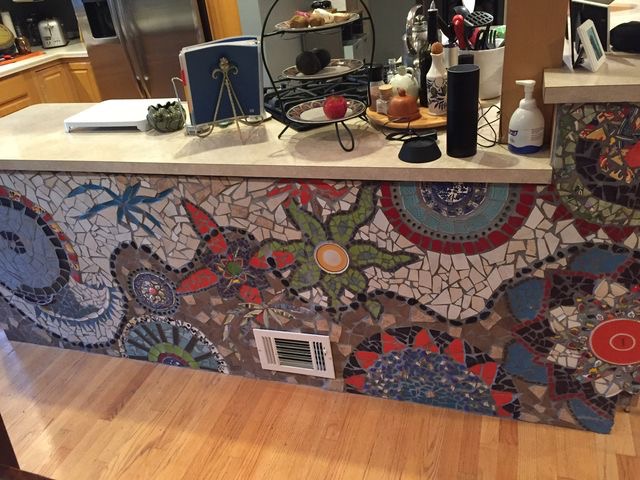
So long, Skokie, and some artwork left behind…You were a warm home for our family!

My partner and I took part in the “great resignation” in 2020 when our tolerance of workplace politics and toxicity, had equally lapsed into resentment, frustration and burnout. A completely new learning opportunity presented itself for each of us and I have spend the last 18 months experiencing continual novice anxiety. We are now living in Ohio, after relocating to Michigan for 12 months prior. Two home sales and two home purchases later, we are unpacked, unfurled and settled? Lots more settling to be done, for sure.

While these new experiences have been no less challenging than what we left behind, they have for me, offered a greater sense that I am bolstered, supported and surrounded by fellow strivers in a new virtual environment. I am beginning to feel some integration, a sense of agency–these seeds I have been sowing have some hope and sunlight ahead for them. I do hope to practice more opportunities for inspiration, writing, art-making; practices I have parked in the boxes which have moved along with our new households. James Clear writes about tying habits to experiences that are enjoyable as well as making them easy enough to come back to regularly in practice. I’m thinking about making a point to visit here daily (ever ambivalent) and perhaps the sense of accountability will emerge again.

“What do they say, when you close a window, a door opens?”
The Ohio door seems welcoming….

OSP–it has been awhile

IMG_0444
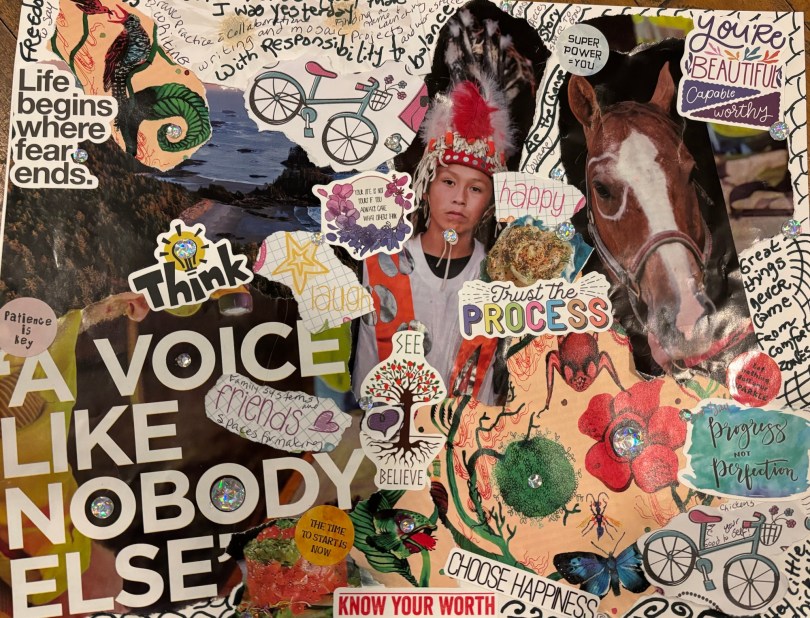
Mandala collage (My witness writing in this post does not correlate to the collage)

I took an Open Studio Process to my daughter’s leadership group at school.  I facilitated them in a process of witnessing the image and a mini collage/mandala process.  It went well.  I learned some things, felt humbled by their earnest brilliance, their pure intent to make the world a better place by ending racism.

Some of my notes from the morning:

Free writing, engage with yourself…I need to get some anxious energy out of my body.  These kids are great and they are all here to do great work and I want so much to provide a gift for them, to honor them and hold them.

My witness: Trees, brown, olive, fatigue greens.  Blankets on a line.  Naturalist, he could be there as a thinker, a ponderer, looking out over the vista of trees and earth.  His clothing and blankets hang on a line, a cup of coffee beside him.  At first glance, I considered that he could be homeless, without shelter and this is his dwelling place, whether by choice or force.  Curves and leaves, one trunk bends, as if a strong breeze pushes it over.  I read about trees that are bent, and how ancient native people here used to bend young trees and tie them down to point toward a path or water source.  It was a means of showing the way to those who would follow.  A large stone sits to the side of this man.  He doesn’t look lonely, but wise, at peace.  He wears glasses and books, signs that he respects the elements, knows his surroundings and chooses to be there.  The landscape of trees seems to go on endlessly and I consider with awe the amount of the earth and planet that is so unknown to me, a mystery, a gift to be discovered.  There is darkness in the forest beyond him, darkness that does not appear ominous or scary, but reflective of the density of a forest and then to think of that going on for miles, with no obvious end.  It is both hopeful and awe-inspiring.  The notion of being small among such greatness, knowing there is space for all, every kind of creature to exist and be nourished.  Sky and clouds shroud the background, fog obscures scale and size.

This is fragmented, I know.  There is something about the reflection of it that feels good.

Taking a walk along Grey Street

imageI heard this song for the first time about 15 years ago and the lyrics registered immediately–I felt so heard, so understood and knew I wasn’t the only person to feel like I did. How could someone with so many talents, with so much going for her and with so many privileges feel so empty? There was no answer in the song, but validation, oh yes.
Grey Street
By: Dave Matthews Band

Look at how she listens
She says nothing of what she thinks
She just goes stumbling through her memories
Staring out onto Grey Street

She thinks Hey, how did I come to this?
I dream myself a thousand times around the world
But I can’t get out of this place.

There’s an emptiness inside her and she’d do anything to fill it in.
But all the colors mix together
to grey
And it breaks her heart.

How she wishes it was different
She prays to God most every night.
And though she swears it doesn’t listen
There’s still a hope in her it might.

She says I pray,
Oh but they all fall on deaf ears
Am I supposed to take it all myself
To get out of this place?

Oh there’s an emptiness inside her
And she’d do anything to fill it in
And though it’s red blood bleeding from Her now,
it feels like cold blue ice in her heart.
When all the colors mix to grey
And it breaks her heart

There’s a stranger speaks outside her door,
Says take what you can from your dreams.
Make them as real as anything
Oh it’d take the work out of the courage.

But she says please
There’s a crazy man that’s creeping outside my door,
I live on the corner of grey street
and the end of the world.

Oh there’s an emptiness inside her
and she’d do anything to fill it in,
and though it’s red blood bleeding from her now it feels like cold blue ice
in her heart.

She feels like kicking out all the windows and setting fire to this life
She could change everything about her
Using colors bold and bright
But all the colors mix together
To grey
And it breaks her heart
To grey.

Grey, not blue, is a much better color metaphor for depression. It is an involuntary, bland and lifeless place tempered by a spectrum of grey–some days feel a bit lighter while others get dark and bleak and the darkness is where the pain is most crippling. It blinds and obscures the ability to see anyone else. Shame, pity and solitary confinement are a heavy, muddy cloak draping and pulling down.

I hope it isn’t redundant to reference song lyrics again.  While I can’t be so histrionic as to say I’ve been “crippled” with grey lately, I have also been in the winter doldrums for sure.  Imagining the connections I can make to other thoughts and heroes, in spite of the chilled dormancy, has helped to prompt and stimulate me, borrow some energy from creative heroes for some inspiration.  And who isn’t inspired by some Dave Matthews?

That I Could be Good

image

Good. Adjective: of high quality;of somewhat high but not excellent quality; correct or proper.
The word is a trigger word for me. One part of good is like being a “good girl,” obedient, submissive, following instructions. As a child I was referred to as a “good girl,” a lot by the men in my life, my dad, my grandfather. Being told I was a good girl, was one of the warmest shows of affection from these men, my inference was they were proud of me, happy and grateful for my good behavior. For years I didn’t understand I was an actual self, and without intention of any kind, lived as the person I thought I was supposed to be, the “good girl.” Gradually, slowly, I saw glimpses of self, and I became less concerned about being a “good girl”–I was in my 30’s by then. The programming pretty embedded. I’m still trapped by the default “good girl” way of relating to men, at the core.

About 10 years ago I heard the following song by Alanis Morissette, “That I would be Good.” I had heard it before, but this was the first time I listened to the lyrics, took them in, understood the meaning of the words. It shook me, stopped me in my tracks and reduced me to red-faced crying, drool, snot and tears smearing together. I could hear the affirmation, that I am a good person, but also understood that I didn’t believe it, that I was not good for every mistake made, for inabilities to perform, for being less than I had hoped. A deeper part of me, one deeper than my more silly, avoidant, parts named so far has held this as truth for a long time. I don’t have much to go on here, but I know it relates to shame, an exile part, isolated and covered up by that hideous shredder guy and little miss perfect.

I told my therapist this song was an epiphany for me. He looked at me and said, “you mean, that you think you aren’t good?” His tone and expression were matching hues of, “I couldn’t be more sad for you, and I didn’t know it was this bad.” Oh the shame that rose up for me with that–I could even make his sadness for me a means of shaming myself. The song became the closest thing to an affirmation I could muster, because still many of the things Morissette said about being good, I didn’t agree with for myself personally. I definitely associated my fails with the opposite of good. Further, some of what she names–losing her hair, going bankrupt, being without someone–I have feared as the ultimate fails, experiences I have been fortunate enough to control and avoid, but would have me crawling under a rock if I did experience them.

That I would be Good
that I would be good even if I did nothing
that I would be good even if I got the thumbs down
that I would be good if I got and stayed sick
that I would be good even if I gained ten pounds

that I would be fine even if I went bankrupt
that I would be good if I lost my hair and my youth
that I would be great if I was no longer queen
that I would be grand if I was not all knowing

that I would be loved even when I numb myself
that I would be good even when I am overwhelmed
that I would be loved even when I was fuming
that I would be good even if I was clingy

that I would be good even if I lost sanity
that I would be good
whether with or without you

I still fill with tears when I read or hear the lyrics. It shows me I have more excavating to do, because how could I not believe I am good? I believe everybody else in the world is good–at their core–can forgive people for doing heinous things, out of compassion for the traumas that led to their behavior. I could share an inventory of the work I do, the kindness and compassion I have in my heart, and in doing so, could also tell you I’m bad–not good–for not being humble. What a mind fuck that is.

The Open Studio Project uses “intention” as a practice of making statements about the present, some are obvious descriptors framed in the positive, others are statements that take the possibility of something and present the idea as though it already is. Of course I struggle with this part of the process. It is very affirmation-like (although intention is not the same as affirmation) and means self-kindness, hopefulness. I’m going to keep working on it.

That’s Not My Name…well sort of

My parents did not name me Penelope, I did.  Penelope isn’t my official name, she is one of my parts.  Penelope was born out of my need to cope with feelings of fear toward my Dad, when I just didn’t know how to connect with him. Penelope is my trickster protector—she wants me to be brave, but helps soften the edges a bit.  She coaxes with childish whimsy, kicking my pants with her clown shoes.  I know in my heart Dad did the best he could.  As for the wounds that remain–sometimes like scabs, that just beg to be picked–I accept them as a part of me, albeit I would really love them to fade away completely like a bruise, because I love my dad and I think he would feel sad and ashamed if I admitted to him that I had felt this way, and still do at times, even in my forties.

I read once that I fit a profile called a “highly sensitive person,” one whose response to stimuli is reactive and vulnerable. My melodrama-scabs are not literal and I wasn’t burned or physically abused by my father— he lacked in the ability to be tender or gentle–qualities we HSP’s need while developing our emotional control panel.  He was an earnest provider for our family.  He worked more than one job, while taking classes too so he could finish his bachelor’s degree. He was tall and imposing, with large hands and broad shoulders. His working hands always looked swollen, like generous sausages filling the casing. He worked on cars in the garage, cut plywood and drywall so he could finish our home that he himself built.

We feared the hands when they started swinging—usually over the front seat of the car to the back seat where we squirmed and cajoled each other.  My brother and I knew we better shape up when the mammoth hand flew over the seat—sliding  to inner and outer edges of the seat, as the hand smacked upholstery instead of fleshy legs or arms, staying  just out of reach, a cat-and-mouse bit that served only to frustrate him more. Not that we wanted to be smacked, but we took some pleasure in the blind searching of his hand while he tried to keep his eyes on the road.  It was not quite as exhilarating as taunting our grandparents’ cat, Mittens, who hated us and when cornered under my grandparents bed would resort to whacking our hands in cartoony-fast thwaps.

Dad worked daily in his garage, shelter from the reality of an overwhelming life of being parent to 4 kids.  Before we had a phone extension out there, we would rock-scissor-paper our way out of having to be the messenger if a phone call came for him.  WHAT do you WANT?!  He would bellow from beneath the chassis he worked on.  Later, he got an extension out there, but I never understood why, because interrupting his process served only to infuriate and annoy him. If the phone was allowed to ring more than 2 or 3 times, he would inevitably lumber to the phone, answer and terrify the caller, because they were sure to hear, “HELLO!!!!” roaring like a grizzly, volume stretched above his stereo and engines.  Everyone knew this was the reality if you had to call our house. Our friends were either terrified or amused by his antics, depending on their previous exposure to his cursing and bellowing.

Calling the house inspired major dread for me.  Of course this was pre-cell phone time, so I couldn’t just choose who I called specifically. Calling home from a friend’s house, so I could ask for a ride, would summon boiling gut-acid.  If Dad answered the phone, I hung up; couldn’t face it and I didn’t dare try again—I would do anything possible to delay making the call again–I’d find a ride, or walk. When I went away to college, I was homesick and really missed my mom, but I continued to hang up if Dad answered. His greeting never changed— he had no idea back then if it was me, no caller ID.  So I would call and pray that my mom would answer and thankfully, most of the time she did.

By the time I was in my twenties, I was really bored with the phone call game, tired of hearing his annoyed barking, when in fact I wouldn’t have minded a conversation with my dad.  I couldn’t reconcile the startled emotions I felt when considering telling him off.  So one day, I braced myself and prepared for the inevitable retort when the lines connected.  I managed to stomp my foot and say, “hello.”  “WHO IS IT?” he yelled, channeling his inner Archie Bunker.  “Well……. it’s …..Penelope,” I offered hopefully.  Pause.  Surprisingly I heard him laugh with surprise–I took him off his guard, reduced the churn of annoyance that so often led his responses.  “Well well well, Penelope who?” he mused and I laughed too, relieved by the way this was going.  We actually talked for a few moments until gruffly he said, “OK, talk to your mom.”

To this day, when I get a message from my Dad to call him back, my first reaction is that child-remembered dread, a slight jolt as the contents of my stomach take a little tilt.  With slight delay–it depends on my vulnerability on a given day– I return the call and wait for his answer, which is much less barky these days.  His “bellow” has “mellowed” over the years.  He still asks, “who is it?” when he answers and my reply remains “It’s Penelope.”  One of my sibs may have told him why I address myself as Penelope on the phone—he’s never asked me why though.  I’m sure a part of him understands down deep, that it would be ok for him to be a little vulnerable…but Penelope is my part, she helped me be vulnerable enough and I love her.